- New
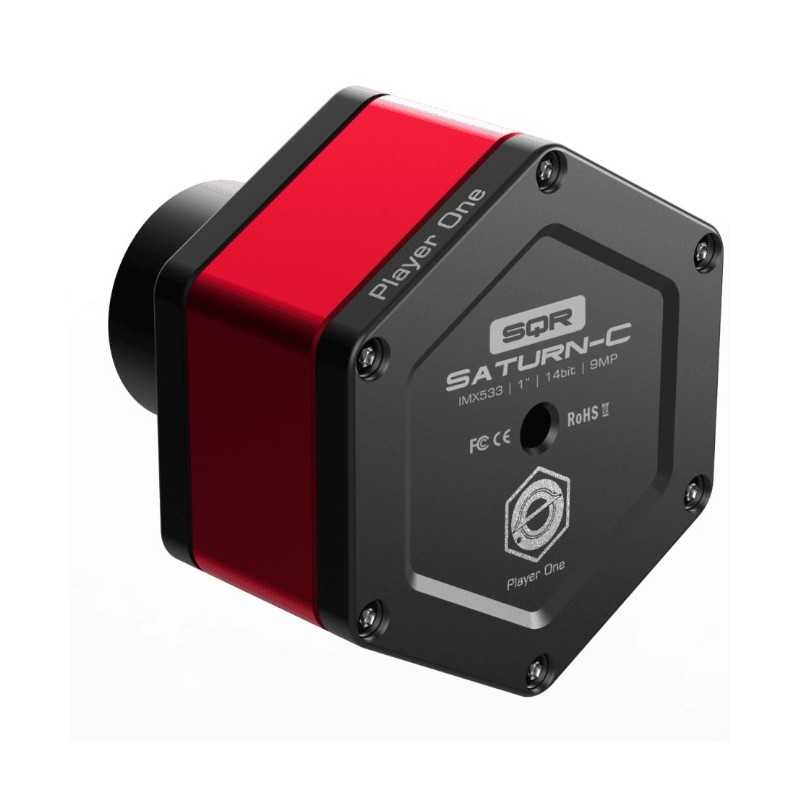






Designed for solar, lunar and planetary imaging, the Player One Saturn-C SQR features a 9 MP Sony IMX533 colour sensor with a 1-inch square format and 3.76 µm pixels. It offers a 73 ke⁻ full-well capacity, 43 fps in RAW8, a 256 MB DDR3 buffer and passive PCS cooling. Compact and lightweight, it is also suitable for deep-sky lucky imaging.
Designed by Player One Astronomy for planetary, lunar and solar imaging, the Saturn-C SQR features a Sony IMX533 colour sensor with a 1-inch square format. Its 11.31 × 11.31 mm imaging area and 16 mm diagonal provide a generous capture area for high-resolution imaging and astronomical mosaics.
With a resolution of 3008 × 3008 pixels, approximately 9 megapixels, and 3.76 µm pixels, it combines a maximum full-well capacity of 73 ke⁻ with native 14-bit analogue-to-digital conversion.
Its back-illuminated CMOS sensor, with a stated peak quantum efficiency of approximately 80%, is also suitable for short-exposure deep-sky imaging, particularly lucky imaging techniques.
Sony STARVIS technology provides the CMOS sensor with a back-illuminated pixel architecture.
The integrated analogue-to-digital converter distinguishes 16,384 conversion levels. This digitisation precision allows variations in light intensity to be recorded while preserving tonal information useful for astronomical image processing.
Equipped with an RGGB Bayer colour filter array, the Sony IMX533 sensor captures the colour information required to reconstruct RGB images.
Player One specifies a peak quantum efficiency of approximately 80%, helping the camera detect faint light signals during astrophotography.
This design allows colour images of the Moon, planets and selected deep-sky objects to be captured without separately recording red, green and blue channels.
With dimensions of 11.31 × 11.31 mm, the sensor features a square format that is particularly useful for framing astronomical subjects and creating mosaics.
Its 3008 × 3008 pixel resolution provides an imaging area suitable for solar and lunar photography. Depending on the focal length used, it is possible to capture the full disc of the Sun or Moon and produce detailed mosaics.
Solar imaging always requires appropriate filtration for the telescope and observing method.
With a maximum full-well capacity of 73 ke⁻, the Saturn-C SQR exceeds the 50 ke⁻ figure specified by Player One for the basic IMX533 version by approximately 46%.
This capacity allows each pixel to accumulate a substantial amount of electrical charge before reaching saturation.
In RAW8 mode, Player One specifies a maximum frame rate of 43 frames per second at full resolution.
The camera can also achieve higher frame rates by reducing the capture area, making it particularly useful for high-resolution planetary imaging.
The stated frame rates over USB 3.0 are:
• 3008 × 3008 pixels: 43 frames per second in RAW8 and 19.5 in RAW16.
• 2560 × 1440 pixels: 95 frames per second in RAW8 and 40 in RAW16.
• 1920 × 1080 pixels: 125 frames per second in RAW8 and 53 in RAW16.
• 1280 × 720 pixels: 185 frames per second in RAW8 and 79 in RAW16.
• 800 × 600 pixels: 220 frames per second in RAW8 and 93 in RAW16.
• 640 × 480 pixels: 272 frames per second in RAW8 and 115 in RAW16.
Actual recording speed also depends on the performance of the computer and storage device.
Two modes allow the camera's operation to be adapted to different imaging requirements:
• Normal mode: a higher frame rate suited to planetary imaging.
• Low Noise mode (LRN): lower readout noise and a wider dynamic range, particularly suitable for deep-sky lucky imaging.
Player One specifies a readout noise range of 4.46 to 1 e⁻, depending on the camera settings.
High Conversion Gain (HCG) mode activates at gain 125.
Player One states that its readout noise figures are obtained from actual measurements. Users can also verify them using the Sensor Analysis function in SharpCap 4.
The Saturn-C SQR is free from amplifier glow, or Amp Glow, avoiding this source of unwanted brightness in long-exposure images.
Player One provides a demonstration dark frame captured with an exposure time of 300 seconds.
This characteristic helps simplify image processing by reducing unwanted brightness gradients caused by the sensor readout electronics.
Thanks to its 1-inch square sensor and 9-megapixel resolution, the Saturn-C SQR is suitable for various astronomical imaging applications.
For lunar photography, its format makes it easier to capture large areas of the lunar surface and produce detailed mosaics.
For solar imaging, the sensor area allows full-disc acquisitions with suitable focal lengths and appropriate solar filtration.
In planetary imaging, the available capture resolutions allow higher frame rates, making it possible to record a large number of frames in a short period.
The Saturn-C SQR can also be used for deep-sky lucky imaging, a technique based on capturing numerous short exposures.
The Saturn-C SQR features a hexagonal body with rounded edges, characteristic of Player One Astronomy's planetary camera range.
Its red and black sandblasted finish combines a rigid structure with a compact design.
With a body diameter of 66 mm and a weight of just 160 g, the camera adds little weight to the imaging equipment and is easy to integrate into different optical configurations.
An integrated tilt adjustment plate allows the inclination of the sensor relative to the optical axis to be corrected.
This mechanism helps improve focus uniformity across the field when sensor tilt or mechanical tolerances affect star shapes.
A high-density foam light seal helps prevent unwanted light from entering through the side gaps.
The Saturn-C SQR features the PCS, or Passive Cooling System, developed by Player One Astronomy.
This system transfers heat generated by the sensor towards the exterior of the camera body.
Unlike the cooled Ares Pro series, the Saturn-C SQR does not include an integrated thermoelectric TEC system allowing a target sensor temperature to be set.
Player One offers the ACS, or Active Cooling System, as an accessory to complement passive PCS cooling.
This external air-cooling system improves heat dissipation, particularly during daytime solar imaging and deep-sky lucky imaging sessions.
According to Player One, combining PCS and ACS can keep the camera temperature approximately 7 °C above ambient under the manufacturer's stated conditions.
The ACS is available as an optional accessory and should not be confused with regulated TEC cooling.
A 256 MB DDR3 buffer helps stabilise data transfers and limit dropped frames during high-speed acquisition.
It also reduces data-transfer demands, including when using a USB 2.0 connection.
This buffer is particularly useful for planetary and lunar recording sequences containing large numbers of frames.
The Saturn-C SQR features Player One's DPS, or Dead Pixel Suppression, technology.
This function analyses dark frames to identify pixels with abnormal behaviour and stores their positions in the camera's memory.
During acquisition, the values of these pixels can be corrected using surrounding pixels according to the method described by the manufacturer.
Equipped with a USB 3.0 interface, the Saturn-C SQR supports fast image transfers to a computer.
The camera is also compatible with USB 2.0 connections, subject to the corresponding bandwidth limitations.
An ST4 port allows the camera to be connected to the autoguiding port of an equatorial mount using a suitable cable.
Player One recommends a high-quality SSD to make full use of the camera's stated recording speeds.
The Saturn-C SQR operates using power supplied through its USB connection.
Overvoltage and overcurrent protection mechanisms help protect the camera and connected equipment.
• Manufacturer: Player One Astronomy.
• Model: Saturn-C SQR.
• Type: colour astronomy camera without TEC cooling.
• Sensor: Sony IMX533 back-illuminated colour CMOS.
• Technology: Sony STARVIS.
• Format: 1-inch square.
• Sensor dimensions: 11.31 × 11.31 mm.
• Sensor diagonal: 16 mm.
• Resolution: 3008 × 3008 pixels, approximately 9 MP.
• Pixel size: 3.76 µm.
• Bayer pattern: RGGB.
• Peak quantum efficiency: approximately 80%.
• Analogue-to-digital converter: native 14-bit.
• Conversion levels: 16,384.
• Shutter type: rolling shutter.
• Exposure range: 32 µs to 2,000 seconds.
• Sampling modes: Normal and Low Noise (LRN).
• Maximum full-well capacity: 73 ke⁻.
• Stated readout noise: 4.46 to 1 e⁻.
• HCG activation: gain 125.
• Amplifier glow: none.
• Stated RAW8 frame rate at full resolution: 43 frames per second.
• Stated RAW16 frame rate at full resolution: 19.5 frames per second.
• Maximum stated RAW8 frame rate at 640 × 480 pixels: 272 frames per second.
• Buffer memory: 256 MB DDR3.
• Dead pixel correction technology: DPS.
• Cooling: Passive Cooling System (PCS).
• External active cooling: optional ACS system.
• Regulated TEC cooling: not included.
• Sensor tilt adjustment: second-generation tilt plate.
• Tilt plate light seal: high-density foam.
• Data interface: USB 3.0.
• USB 2.0 connection: supported.
• Autoguiding port: ST4.
• Connection thread: M42 × 0.75.
• Adapter: 1.25 inch.
• Mechanical backfocus: 12.5 mm.
• Protective window: 32 mm diameter, 2 mm thickness, AR Plus multi-layer anti-reflective coating.
• Electrical protection: overvoltage and overcurrent.
• Manufacturer's recommended storage: a quality SSD.
• Body shape: hexagonal with rounded edges.
• Exterior finish: sandblasted.
• Colours: red and black.
• Body diameter: 66 mm.
• Weight: 160 g.
.png)
.png)
.png)
.png)
.png)
.png)
.png)
.png)
.png)
.png)
.png)
.png)
.png)

You might also like
Designed for solar, lunar and planetary imaging, the Player One Saturn-C SQR features a 9 MP Sony IMX533 colour sensor with a 1-inch square format and 3.76 µm pixels. It offers a 73 ke⁻ full-well capacity, 43 fps in RAW8, a 256 MB DDR3 buffer and passive PCS cooling. Compact and lightweight, it is also suitable for deep-sky lucky imaging.