- Telescopes
- Mounts
- Binoculars and Spotting Scopes
- Accessoires
- Accessoires non optiques
- Focusers and Motor Drives
- Autofocuser Bracket
- T-Rings and Photo Adapters
- Extension and conversion rings
- Bahtinov Masks
- Dovetail Bars and Clamps
- Filter Wheels, Filter Drawers and Baader UFC Systems
- Anneaux de guidage
- Tilt Adjusters
- Telescope Carry Handles
- Collimation Instruments
- Transport Cases and Bags
- Automation & Calibration
- Control and Power Modules
- Focus assistance
- OAG (Off-Axis Guiders) and Guide Scopes
- Automated Tilt Adjustment
- Wheels and filter drawers
- Field Rotator
- Polar alignment assist
- Dew Heaters and Shields
- Flat Field Panels
- Photo adapters
- Pointing assistance system
- Batteries and 12V / 24V Power Supplies
- Power Cables and Connectors
- Accessoires optiques
- Eyepieces and Barlow Lenses
- Astronomical Filters
- Miscellaneous and Cleaning Accessories
- Solar Observing Modules and Accessories
- Books and Guides
- Accessoires non optiques
- Astro Cameras
- Microscopes
- Used Equipment
- Courses & Trainings
- Observatories
- About
- PICTURES
- Home
- Telescopes
- Mounts
- Astro Cameras
- Accessoires
- Accessoires non optiques
- Automation & Calibration
- Control and Power Modules
- Focus assistance
- OAG (Off-Axis Guiders) and Guide Scopes
- Automated Tilt Adjustment
- Wheels and filter drawers
- Field Rotator
- Polar alignment assist
- Dew Heaters and Shields
- Flat Field Panels
- Photo adapters
- Pointing assistance system
- Batteries and 12V / 24V Power Supplies
- Power Cables and Connectors
- Accessoires optiques
- Eyepieces and Barlow Lenses
- Astronomical Filters
- Miscellaneous and Cleaning Accessories
- Solar Observing Modules and Accessories
- Books and Guides
- Accessoires non optiques
- Binoculars and Spotting Scopes
- Microscopes
- Used Equipment
- Telescopes
Spotting Scopes

Discover our selection of spotting scopes for birdwatching, wildlife observation and exploring distant landscapes. Designed to provide detailed views of distant subjects, these optical instruments offer magnification ranges suited to nature observation.
From versatile models to spotting scopes featuring low-dispersion optical glass, Astromanie offers instruments for different observing requirements and levels of experience.
Certain spotting scopes can also be used for astronomical observation, particularly for exploring lunar features.
Benefit from specialist advice to choose a spotting scope suited to your observing needs, expectations and budget.
There are 4 products.
Active filters
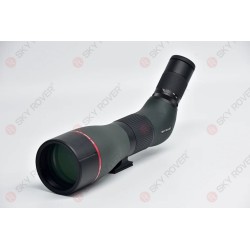


Celestron TrailSeeker 80 mm...
- -5%
How to choose a spotting scope for nature observation
Spotting scopes allow detailed observation of distant subjects, generally at higher magnifications than conventional binoculars. They are particularly useful for birdwatching, wildlife observation and exploring distant landscapes.
Several optical and practical characteristics should be considered when choosing the right instrument.
Magnification and objective lens diameter
Magnification makes distant subjects appear larger and allows finer details to be observed. Many spotting scopes feature a zoom eyepiece, allowing magnification to be adjusted without changing eyepieces.
Objective lens diameter influences the amount of light collected. Large-aperture models can offer advantages in low-light conditions, particularly at dawn and dusk.
However, higher magnification generally reduces the field of view and makes vibrations more noticeable.
Optical quality and ED glass
The quality of optical components plays an essential role in image sharpness, contrast and colour accuracy.
Certain models incorporate Extra-low Dispersion (ED) glass to reduce chromatic aberration and improve image quality.
Anti-reflective optical coatings also help reduce unwanted reflections and improve light transmission.
Straight or angled spotting scope?
Spotting scopes are available in different configurations.
Straight models generally make it easier to aim at subjects located approximately at eye level.
Angled spotting scopes can provide a more comfortable viewing position, particularly during extended observations or when several people share the same instrument.
The best configuration depends on individual preferences and observing conditions.
Why a tripod matters
Unlike compact binoculars, spotting scopes are generally designed to be used with a tripod.
A stable support reduces vibrations and allows the instrument's optical performance to be fully appreciated, particularly at higher magnifications.
Tripod selection should take into account the spotting scope's weight, stability requirements and handling comfort.
Can spotting scopes be used for astronomy?
Certain spotting scopes can also be used to explore the night sky.
The Moon is a particularly interesting target, allowing observers to discover its craters, surface features and darker regions.
Depending on the optical characteristics of the instrument and observing conditions, some planetary observation may also be possible.
For exploring wide star fields or practising astronomy regularly, astronomical binoculars or a dedicated telescope may be more suitable.
Specialist advice from Astromanie
Choosing a spotting scope should not depend solely on maximum magnification. Optical quality, brightness, stability and viewing comfort are equally important.
Astromanie provides specialist advice to help you select an instrument suited to birdwatching, terrestrial observation or astronomy.