- New
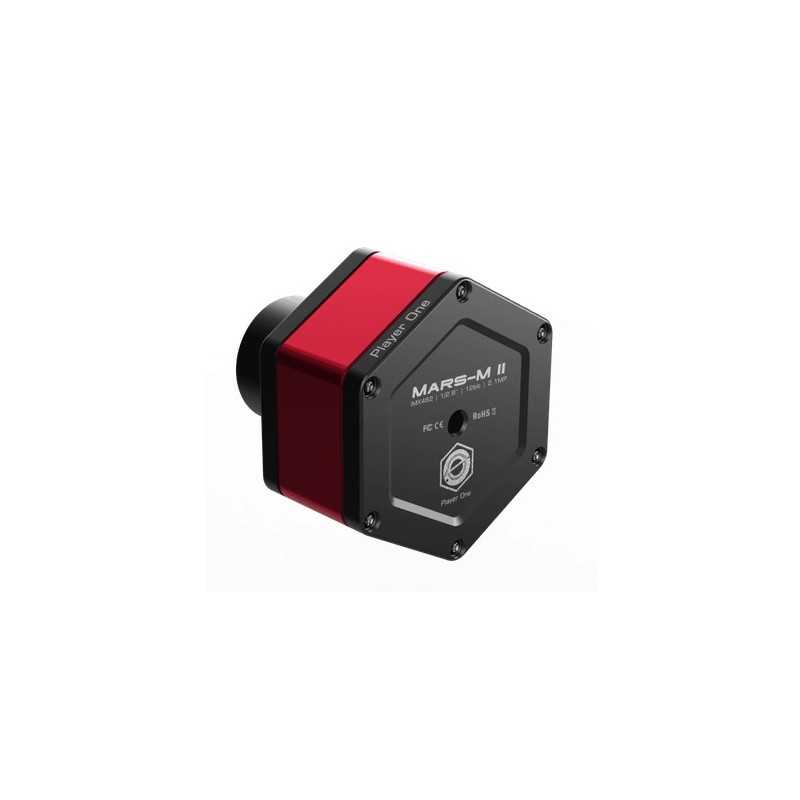


Designed for planetary, solar and lunar imaging, the Player One Mars-M II features a 2.1 MP Sony IMX462 monochrome sensor with 2.9 µm pixels. It offers approximately 91% peak quantum efficiency, 136 fps, a 256 MB DDR3 buffer and a Super AR Plus window optimised for UV and near-infrared transmission. It is also suitable for Electronically Assisted Astronomy.
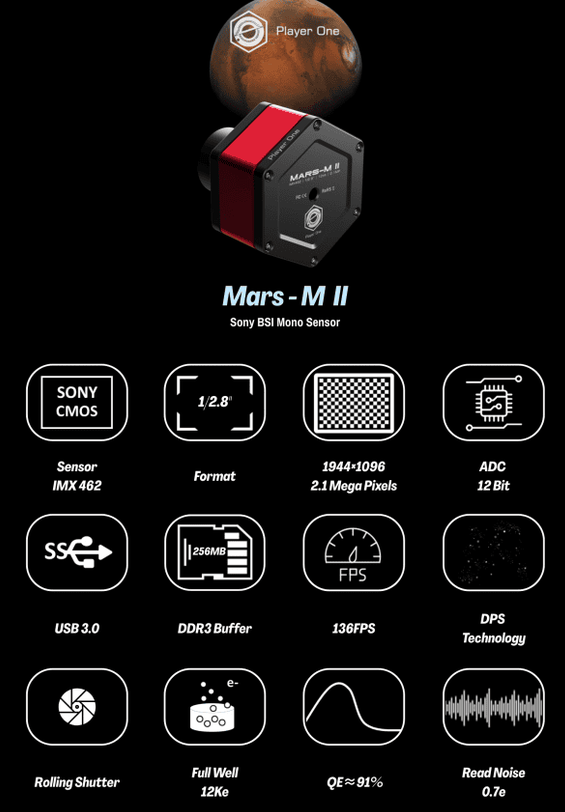
Designed by Player One Astronomy for planetary, lunar and solar imaging, the Mars-M II features a Sony IMX462 monochrome sensor with a 1/2.8-inch format. Its 5.6 × 3.2 mm imaging area and approximately 6.5 mm diagonal provide a capture field suited to high-resolution astronomical imaging.
With a resolution of 1944 × 1096 pixels, approximately 2.1 megapixels, and 2.9 µm pixels, it combines a maximum full-well capacity of 12 ke⁻ with native 12-bit analogue-to-digital conversion.
Its monochrome CMOS sensor, with a stated peak quantum efficiency of approximately 91%, offers particularly interesting sensitivity in the red and near-infrared regions. The Mars-M II is also suitable for Electronically Assisted Astronomy (EAA).
Without a colour filter array, the Sony IMX462 monochrome sensor directly records the light intensity received by each pixel.
This design eliminates the need for colour interpolation associated with Bayer-pattern sensors and is particularly useful for high-resolution astronomical imaging.
Its native 12-bit analogue-to-digital converter distinguishes 4,096 conversion levels, allowing variations in light intensity to be recorded for astronomical image processing.
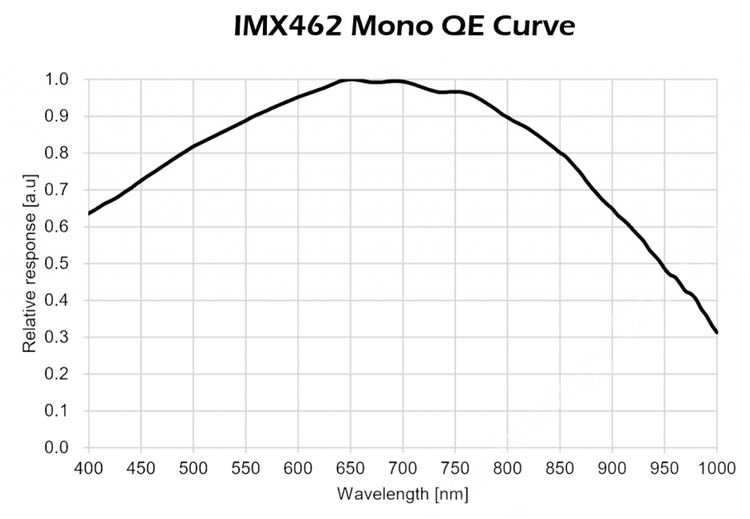
Player One specifies a peak quantum efficiency of approximately 91% for the monochrome Sony IMX462 sensor.
The quantum efficiency curve published by the manufacturer shows particularly high sensitivity between 650 and 700 nm, with a strong response extending into the near-infrared region.
This characteristic is useful for planetary imaging with red and infrared filters, especially when recording atmospheric details.
Combined with suitable filters, the camera can also be used for different spectral imaging applications.
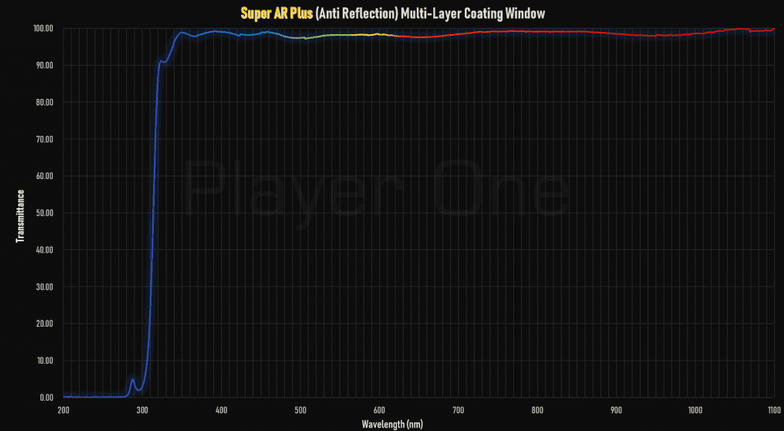
The Mars-M II features a Super AR Plus protective window designed to provide high light transmission across an extended spectral range.
Player One specifies particularly favourable transmission between 310 and 1100 nm, covering part of the ultraviolet spectrum, visible light and near-infrared wavelengths.
This window helps make full use of the monochrome sensor's capabilities when imaging with specialised filters.
Ultraviolet and solar imaging nevertheless require appropriate optical systems and suitable filters for the wavelengths being observed.
With dimensions of 5.6 × 3.2 mm, the Sony IMX462 sensor features a compact format particularly suited to planetary imaging.
Its 1944 × 1096 pixel resolution allows detailed image sequences of Jupiter, Saturn, Mars and different regions of the lunar surface to be recorded.
The actual field of view depends on the focal length of the optical instrument.
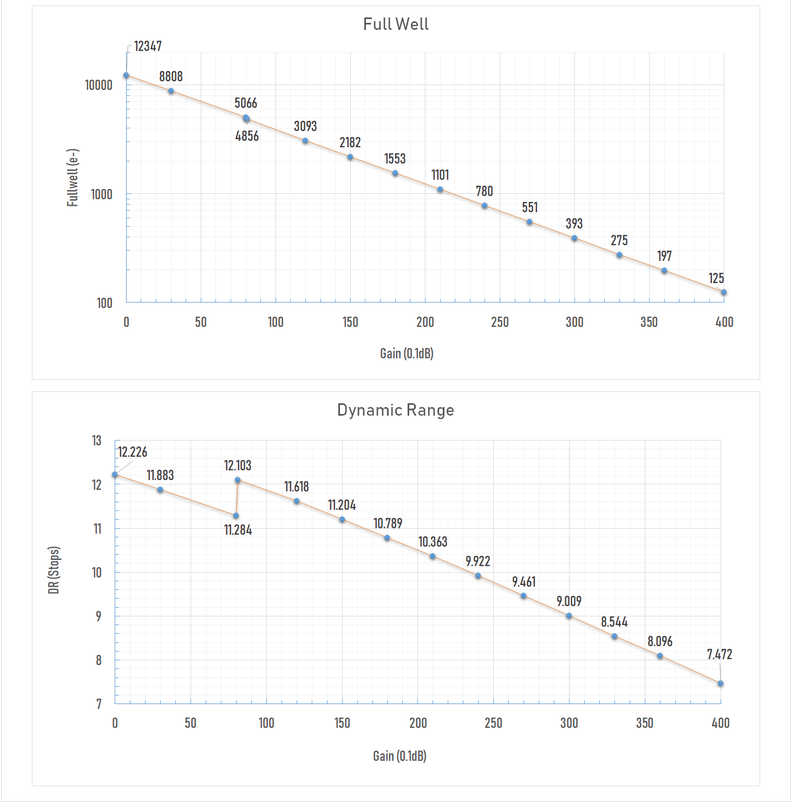
With a maximum full-well capacity of 12 ke⁻, the Mars-M II can accumulate approximately 12,000 electrons per pixel before saturation, depending on the readout conditions.
This capacity is one of the Sony IMX462 sensor's characteristics and should be considered alongside its readout noise and quantum efficiency.
With a USB 3.0 connection, the Mars-M II can reach 136 frames per second at full resolution in RAW8 mode, using 10-bit ADC readout.
Higher frame rates can be achieved by reducing the capture area, making the camera particularly useful for high-resolution planetary imaging.
The frame rates specified by Player One are:
• 1944 × 1096 pixels: 136 frames per second in RAW8 and 62.5 in RAW16.
• 1920 × 1080 pixels: 138 frames per second in RAW8 and 63.5 in RAW16.
• 1280 × 720 pixels: 205 frames per second in RAW8 and 94.1 in RAW16.
• 800 × 600 pixels: 245 frames per second in RAW8 and 112.4 in RAW16.
• 640 × 480 pixels: 304 frames per second in RAW8 and 139.3 in RAW16.
Additional resolutions can be configured in the acquisition software.
Actual recording speed also depends on the performance of the computer and storage device.
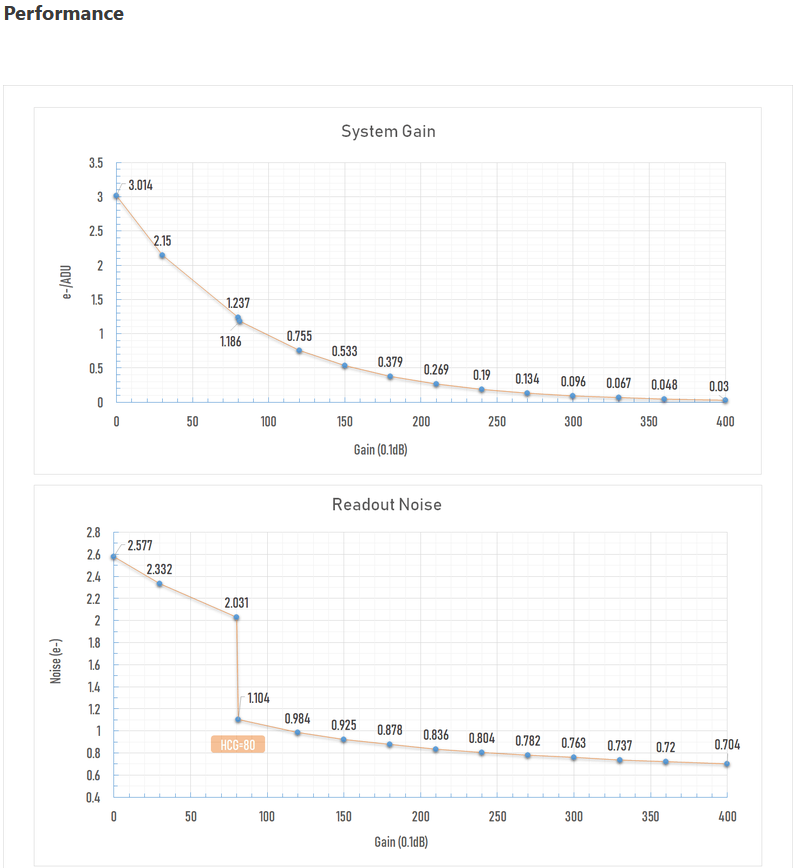
The Mars-M II features a High Conversion Gain (HCG) mode that activates automatically at gain 80 and above.
This mode reduces readout noise while maintaining useful dynamic range at higher gain settings.
Player One specifies a readout noise range of 2.6 to 0.7 e⁻, depending on the camera settings.
The manufacturer reports the following measurements:
• At gain 350: approximately 0.73 e⁻ readout noise.
• At gain 400: approximately 0.7 e⁻ readout noise.
These values come from measurements performed by Player One. Users can also check readout noise using the Sensor Analysis function in SharpCap 4.
The Mars-M II is free from amplifier glow, or Amp Glow, avoiding this source of unwanted brightness in long-exposure images.
Player One provides comparative dark frames illustrating the camera's performance.
This characteristic helps simplify image processing by reducing unwanted brightness gradients caused by the readout electronics.
Thanks to its monochrome Sony IMX462 sensor and high acquisition speed, the Mars-M II is particularly well suited to high-resolution planetary imaging.
When photographing Jupiter, Saturn or Mars, it can rapidly record large numbers of frames, which can then be selected and stacked to improve the signal-to-noise ratio and reveal fine details.
For lunar photography, its 2.9 µm pixels allow different regions of the surface to be captured and detailed mosaics to be produced.
For solar imaging, the monochrome sensor can be used with suitable filtration systems, including H-alpha. The Super AR Plus window is also useful for certain ultraviolet imaging applications, provided that the optical system is appropriately configured.
Solar imaging always requires proper safety filtration matched to the telescope.
The Mars-M II features a hexagonal body with rounded edges, characteristic of Player One Astronomy's planetary camera range.
Its red and black sandblasted finish combines a rigid structure with a compact design.
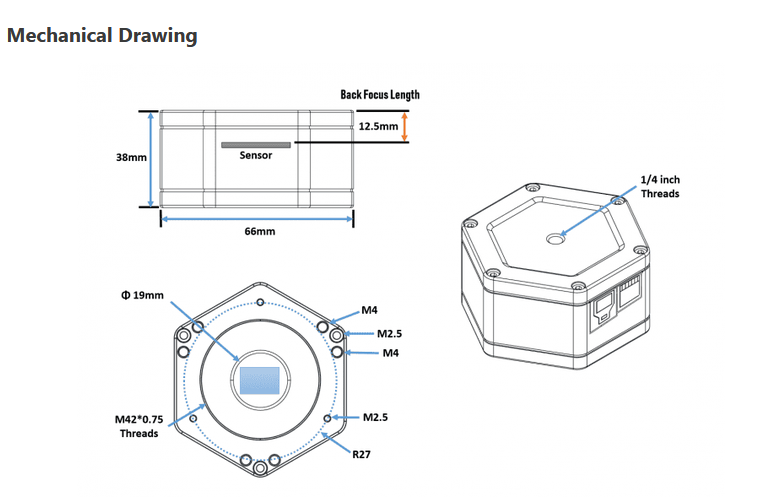
With a body diameter of 66 mm and a weight of 180 g, the camera adds little weight to the imaging equipment and is easy to integrate into different optical configurations.
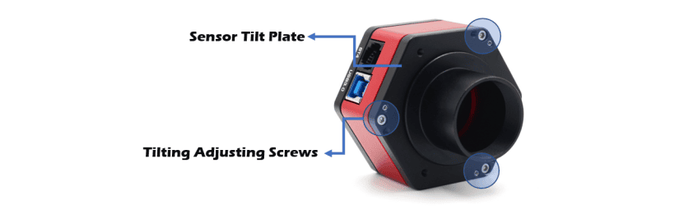
An integrated tilt adjustment plate allows the inclination of the sensor relative to the optical axis to be corrected.
This mechanism is particularly useful for solar imaging when Newton's rings appear with certain H-alpha optical systems.
Slightly adjusting the sensor tilt can help reduce or eliminate these interference patterns in suitable configurations.
A high-density foam light seal helps prevent unwanted light from entering through the side gaps.
A 256 MB DDR3 buffer helps stabilise data transfers and limit dropped frames during high-speed acquisition.
It also reduces data-transfer demands, including when using a USB 2.0 connection.
This buffer is particularly useful for planetary and solar recording sequences containing large numbers of frames.
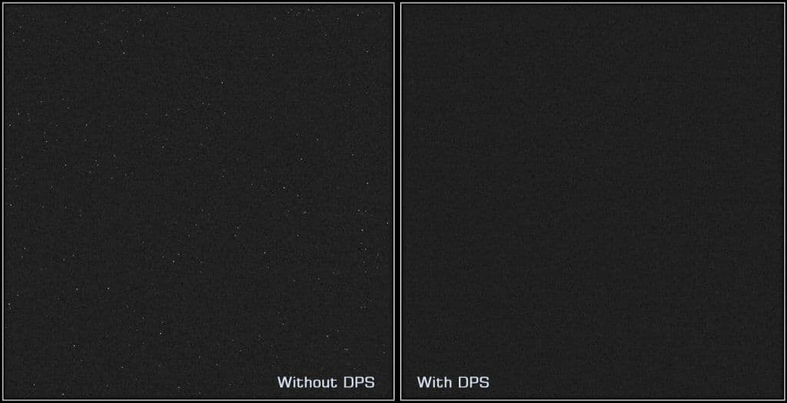
The Mars-M II features Player One Astronomy's DPS, or Dead Pixel Suppression, technology.
This function analyses several dark frames to identify pixels with abnormal behaviour and stores their positions in the camera's memory.
During acquisition, these pixel values can be corrected using surrounding pixels according to the method described by the manufacturer.
Equipped with a USB 3.0 interface, the Mars-M II supports fast image transfers to a computer.
The camera is also compatible with USB 2.0 connections, subject to the corresponding bandwidth limitations.
An ST4 port allows the camera to be connected to the autoguiding port of an equatorial mount using a suitable cable.
Player One recommends a high-quality SSD to make full use of the camera's stated recording speeds.
The Mars-M II operates using power supplied through its USB connection.
Overvoltage and overcurrent protection mechanisms help protect the camera and connected equipment.
• Manufacturer: Player One Astronomy.
• Model: Mars-M II.
• Type: monochrome astronomy camera.
• Sensor: Sony IMX462 monochrome CMOS.
• Format: 1/2.8 inch.
• Sensor dimensions: 5.6 × 3.2 mm.
• Sensor diagonal: approximately 6.5 mm.
• Resolution: 1944 × 1096 pixels, approximately 2.1 MP.
• Pixel size: 2.9 µm.
• Peak quantum efficiency: approximately 91%.
• Analogue-to-digital converter: native 12-bit.
• Conversion levels: 4,096.
• Shutter type: rolling shutter.
• Exposure range: 32 µs to 2,000 seconds.
• Maximum full-well capacity: 12 ke⁻.
• Stated readout noise: 2.6 to 0.7 e⁻.
• HCG activation: gain 80.
• Readout noise at gain 350: approximately 0.73 e⁻.
• Readout noise at gain 400: approximately 0.7 e⁻.
• Amplifier glow: none.
• Stated RAW8 frame rate at full resolution: 136 frames per second.
• Stated RAW16 frame rate at full resolution: 62.5 frames per second.
• Maximum stated RAW8 frame rate at 640 × 480 pixels: 304 frames per second.
• Buffer memory: 256 MB DDR3.
• Dead pixel correction technology: DPS.
• Data interface: USB 3.0.
• USB 2.0 connection: supported.
• Autoguiding port: ST4.
• Connection thread: M42 × 0.75.
• Adapter: 1.25 inch.
• Mechanical backfocus: 12.5 mm.
• Protective window: Super AR Plus, 21 mm diameter and 1.1 mm thickness.
• Stated window spectral range: 310 to 1100 nm.
• Sensor tilt adjustment: second-generation tilt plate.
• Tilt plate light seal: high-density foam.
• Electrical protection: overvoltage and overcurrent.
• Manufacturer's recommended storage: a high-quality SSD.
• Body shape: hexagonal with rounded edges.
• Exterior finish: sandblasted.
• Colours: red and black.
• Body diameter: 66 mm.
• Weight: 180 g.

You might also like
Designed for planetary, solar and lunar imaging, the Player One Mars-M II features a 2.1 MP Sony IMX462 monochrome sensor with 2.9 µm pixels. It offers approximately 91% peak quantum efficiency, 136 fps, a 256 MB DDR3 buffer and a Super AR Plus window optimised for UV and near-infrared transmission. It is also suitable for Electronically Assisted Astronomy.