- New
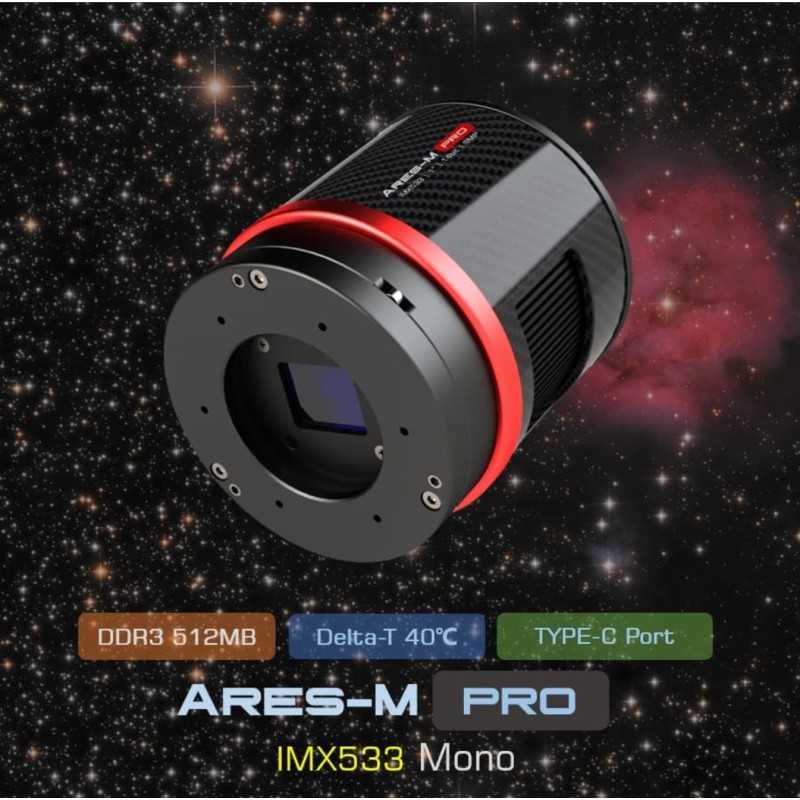






Designed for deep-sky astrophotography, the Player One Ares-M Pro features a 9 MP Sony IMX533 monochrome sensor with a 1-inch square format and 3.76 µm pixels. It offers a 73 ke⁻ full-well capacity, two-stage TEC cooling and a 512 MB DDR3 buffer. Suitable for LRGB and SHO imaging, it also supports solar, lunar and planetary imaging.
With a resolution of 3008 × 3008 pixels, approximately 9 megapixels, and 3.76 µm pixels, it combines a maximum full-well capacity of 73 ke⁻ with native 14-bit analogue-to-digital conversion.
Its monochrome sensor, with a stated peak quantum efficiency of approximately 91%, is particularly well suited to deep-sky imaging using LRGB and narrowband filters, including H-alpha, OIII and SII.
Sony STARVIS technology provides the CMOS sensor with a back-illuminated pixel architecture.
The integrated analogue-to-digital converter distinguishes 16,384 conversion levels. This digitisation precision makes it possible to record variations in light intensity and preserve tonal detail during astronomical image processing.
Without a colour filter array, the Sony IMX533 monochrome sensor records the light intensity received by each pixel without separating it into red, green and blue components.
Player One specifies a peak quantum efficiency of approximately 91%, helping the camera detect faint light signals during astrophotography.
Combined with a filter wheel, the Ares-M Pro supports LRGB imaging and narrowband acquisition in H-alpha, OIII and SII.
With dimensions of 11.31 × 11.31 mm, the sensor features a square format that is particularly useful for framing a wide range of astronomical objects.
Its 3008 × 3008 pixel resolution also provides an imaging area suitable for solar and lunar photography. Depending on the focal length used, it is possible to capture the full disc of the Sun or Moon and produce mosaics.
The Ares series features a circular body combining Player One Astronomy's distinctive red and black colours.
The use of carbon fibre and an optimised structural design keeps the camera's weight down to just 420 g.
Despite its compact size, the Ares-M Pro integrates a thermoelectric cooling system, an anti-dew heater and a sensor tilt adjustment mechanism.
To correct sensor inclination relative to the optical axis, the Ares-M Pro offers two adjustment solutions.
• Front three-point tilt plate: supplied as standard with the camera, allowing sensor tilt correction in conventional imaging configurations.
• Rear four-point tilt plate: available as an alternative, making adjustment easier when the camera is combined with a filter wheel, filter drawer or off-axis guider with a fixed orientation.
The rear adjustment configuration is also particularly useful for RASA telescope users.
A high-density foam light seal helps prevent unwanted light from entering through the side gaps.
With a maximum full-well capacity of 73 ke⁻, the Ares-M Pro exceeds the 50 ke⁻ figure specified by Player One for the basic IMX533 version by approximately 46%.
This capacity allows each pixel to accumulate a substantial amount of electrical charge before reaching saturation.
In RAW8 mode, Player One specifies a maximum frame rate of 43 frames per second at full resolution.
This allows the camera to be used for both long-exposure deep-sky imaging and high-speed acquisition of the Moon, Sun and planets.
Two modes allow the camera's operation to be adapted to different imaging requirements:
• Normal mode: a higher frame rate suited particularly to planetary imaging.
• Low Noise mode (LRN): lower readout noise and a wider dynamic range suited to deep-sky imaging.
Player One specifies a readout noise range of 4.46 to 1 e⁻, depending on the camera settings.
The Ares-M Pro is free from amplifier glow, or Amp Glow, avoiding this source of unwanted brightness in long-exposure images.
The manufacturer's demonstration dark frame was captured with the following settings:
• Exposure time: 300 seconds.
• Gain: 0.
• Offset: 10.
• Temperature: −10 °C.
• Display: automatic STF stretching in PixInsight 1.86.
Player One specifies the following dark current values:
• At −20 °C: 0.000044 e⁻/s/pixel.
• At 0 °C: 0.000996 e⁻/s/pixel.
These low values help limit unwanted thermal signals during long-exposure imaging.
The camera features a two-stage thermoelectric cooling system and a design intended to limit heat flowing back towards the sensor chamber.
Player One specifies a temperature difference of 35 to 40 °C below ambient temperature.
The operating conditions specified for this performance are:
• Ambient temperature: 30 °C.
• Fan speed: 100%.
• Anti-dew heater power: 1%.
For routine use, the manufacturer recommends:
• Target temperature: 30 to 35 °C below ambient.
• Fan speed: 50 to 70%.
• Anti-dew heater power: 10%.
• Stated power usage under these conditions: 40 to 60%.
Three parameters can be adjusted through the ASCOM interface:
• Target temperature.
• Fan speed.
• Anti-dew heater power.
The default fan speed is 50%. An integrated heater at the front of the camera helps prevent dew formation, with adjustable power to suit operating conditions.
A 512 MB DDR3 buffer helps stabilise data transfers and limit dropped frames.
It also reduces data-transfer demands, including when using a USB 2.0 connection.
Two rear USB-C data ports sit alongside the power connector. The USB-C format makes connections easier when setting up imaging equipment at night.
The main port supports USB 3.0, allowing the camera to reach 43 frames per second in RAW8 mode at full resolution.
Actual recording speed also depends on storage performance. Player One recommends a quality SSD to make full use of the camera's capabilities.
A 12 V DC input with a 5.5 × 2.1 mm connector supplies the power required for TEC cooling.
When cooling is not needed, connecting the main USB-C port is sufficient to operate the camera in uncooled mode.
Overvoltage and overcurrent protection mechanisms help protect the camera and connected equipment.
• Manufacturer: Player One Astronomy.
• Model: Ares-M Pro.
• Type: cooled monochrome astronomy camera.
• Sensor: Sony IMX533 back-illuminated monochrome CMOS.
• Technology: Sony STARVIS.
• Format: 1-inch square.
• Sensor dimensions: 11.31 × 11.31 mm.
• Sensor diagonal: 16 mm.
• Resolution: 3008 × 3008 pixels, approximately 9 MP.
• Pixel size: 3.76 µm.
• Peak quantum efficiency: approximately 91%.
• Analogue-to-digital converter: native 14-bit.
• Conversion levels: 16,384.
• Shutter type: rolling shutter.
• Exposure range: 32 µs to 2,000 seconds.
• Sampling modes: Normal and Low Noise (LRN).
• Maximum full-well capacity: 73 ke⁻.
• Stated readout noise: 4.46 to 1 e⁻.
• Dark current at −20 °C: 0.000044 e⁻/s/pixel.
• Dark current at 0 °C: 0.000996 e⁻/s/pixel.
• Amplifier glow: none.
• Stated RAW8 frame rate: 43 frames per second at full resolution.
• Stated RAW16 frame rate: 19.5 frames per second at full resolution.
• Buffer memory: 512 MB DDR3.
• Cooling: two-stage TEC.
• Stated Delta-T: 35 to 40 °C below ambient temperature.
• Recommended Delta-T: 30 to 35 °C below ambient temperature.
• Anti-dew heater: integrated, adjustable power.
• Cooling fan: adjustable speed, 50% by default.
• Adjustable ASCOM parameters: target temperature, fan speed and anti-dew heater power.
• Sensor tilt adjustment: three points at the front or four points at the rear with an alternative tilt plate.
• Tilt plate light seal: high-density foam.
• Data ports: two USB-C ports.
• Main port protocol: USB 3.0.
• USB 2.0 connection: supported.
• Cooling power supply: 12 V DC.
• Power connector: 5.5 × 2.1 mm.
• Stated maximum power consumption: 3 A at 12 V.
• Recommended external power supply: 12 V, minimum 5 A.
• Uncooled operation: powered through the main USB-C port.
• Electrical protection: overvoltage and overcurrent.
• Manufacturer's recommended storage: a quality SSD.
• Body shape: circular.
• Material: structure incorporating carbon fibre.
• Colours: red and black.
• Body diameter: 78 mm.
• Weight: 420 g.
• Mechanical backfocus: 17.5 mm.
• Connection thread: M42 × 0.75.
• Adapter: 1.25 inch.
• Protective window: 32 mm diameter, 2 mm thickness, AR Plus multi-layer anti-reflective coating.
.png)
.png)
.png)
.png)
.png)
.png)
.png)

You might also like
Designed for deep-sky astrophotography, the Player One Ares-M Pro features a 9 MP Sony IMX533 monochrome sensor with a 1-inch square format and 3.76 µm pixels. It offers a 73 ke⁻ full-well capacity, two-stage TEC cooling and a 512 MB DDR3 buffer. Suitable for LRGB and SHO imaging, it also supports solar, lunar and planetary imaging.