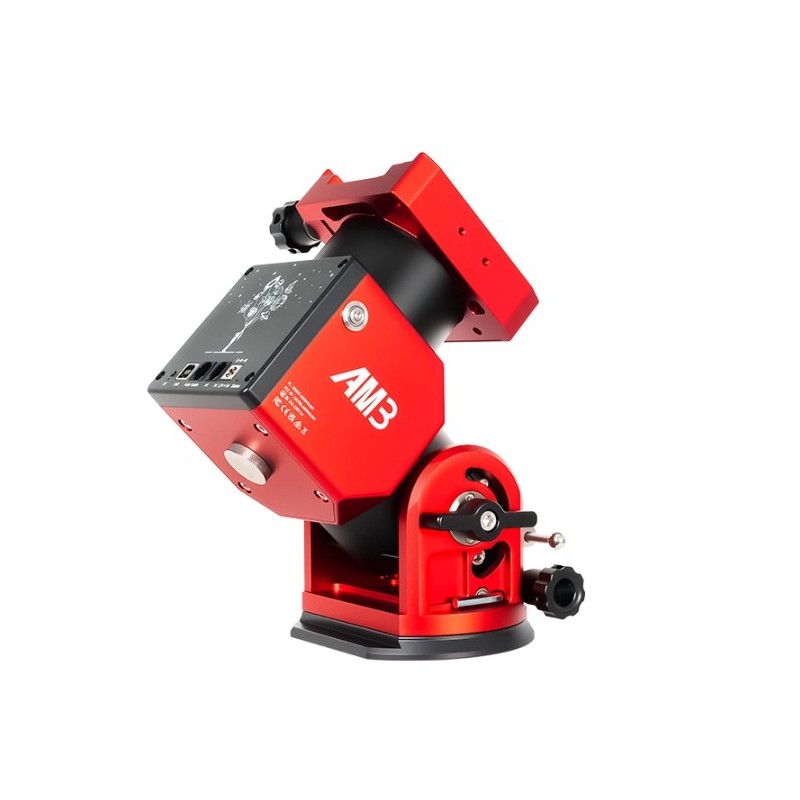


Compact ZWO AM3N harmonic mount with TC40 carbon fibre tripod, designed for portable astrophotography and visual observing. It provides equatorial and alt-azimuth modes, an 8 kg reference payload without counterweight and up to 13 kg with counterweight, with integrated Wi-Fi and Bluetooth.
Designed to provide a compact, precise and highly portable solution, the ZWO AM3N combines a strain wave gear drive with a synchronous belt in a mount weighing only 4.1 kg.
This version is supplied with the ZWO TC40 carbon fibre tripod. Together they provide a configuration particularly suited to travel and portable astrophotography while maintaining a rigid and stable support for the mount.
The new-generation AM3N improves portability, cable management and wireless control. The dovetail saddle integrates Type-C and 12 V DC connections to reduce cable clutter, while a magnetic hex key can remain attached directly to the mount for convenient access.
The drive system combines a strain wave gear reducer with a synchronous belt and an overall reduction ratio of 300:1. This design is intended to provide smooth movement, substantial torque and the precision required for long-exposure imaging.
Every AM3N is individually tested and supplied with its own periodic-error curve report. ZWO maintains periodic error within ±15 arc-seconds.
The mount can operate in both equatorial and alt-azimuth modes. This allows it to be used for astrophotography with equatorial tracking or for visual observation.
Its 0 to 90° altitude range provides operation across both low- and high-latitude regions.
Wi-Fi and Bluetooth are built directly into the mount. The AM3N can therefore be controlled from a smartphone without requiring a hand controller.
The compatible mobile application provides several control functions including an on-screen joystick, Tonight’s Target, GoTo and Live Preview.
The AM3N is also compatible with ASCOM, INDI and ASIAIR, allowing integration into a wide range of astrophotography configurations.
Technical Specifications
• Manufacturer : ZWO
• Model : AM3N
• Tripod : ZWO TC40
• Type : Strain wave gear mount
• Modes : Equatorial and alt-azimuth
• Drive : Strain wave gear and synchronous belt
• Reduction ratio : 300:1
• Periodic error : ±15 arc-seconds
• Individual periodic-error report : Included
• Mount weight : 4.1 kg
• Reference payload without counterweight : 8 kg
• Maximum reference torque without counterweight : 16 N·m
• Reference payload with counterweight : 13 kg
• Maximum torque with counterweight : 26 N·m
• Recommended counterweight : Maximum 5 kg
• Position with 5 kg counterweight : 20 to 30 cm
• Recommended counterweight torque : 10 to 15 N·m
• Altitude range : 0 to 90°
• First altitude range : 0 to 60°
• Second altitude range : 30 to 90°
• Saddle Type-C connection : Yes
• Saddle 12 V DC output : Yes
• Integrated cable management : Yes
• Magnetic hex key : Yes
• Wi-Fi : Built in
• Bluetooth : Built in
• Smartphone control : Yes
• Hand controller required for wireless control : No
• GoTo : Yes
• Tonight’s Target : Yes
• Live Preview : Yes
• ASIAIR compatibility : Yes
• ASCOM compatibility : Yes
• INDI compatibility : Yes
• Status light indicator : Yes
• Tripod material : Carbon fibre
• TC40 weight : 2.3 kg
• TC40 load capacity : 50 kg
• Minimum TC40 height : 470 mm
• Maximum TC40 height : 800 mm
• Folded length : 500 mm
• Leg sections : 2
• Upper leg diameter : 40 mm
• Lower leg diameter : 36 mm
• Spreader plate : Yes
• Weight bag : Included
• Stainless-steel spikes : Included
Package Contents
• ZWO AM3N mount
• ZWO TC40 carbon fibre tripod
• TC40 weight bag
• 3 stainless-steel spikes
• 2.5 mm TC40 hex wrench
• 6 mm TC40 hex wrenches


Tired of Complicated Mount Wiring?
Messy cables can easily get tangled and even damage your gear.
Frustrated with Heavy Gear During Field Trips?
Transporting bulky setups can drain your energy before you even start imaging.
Still Struggling with Star Trails and Poor Tracking?
Losing pinpoint stars due to inaccurate tracking ruins the perfect shot.

Engineered for simplicity: two cables deliver a clean, efficient setup that gets you imaging faster than ever.

Astrophotography demands both stability and accuracy, and the adoption of a custom-engineered strain wave gear system addresses these needs directly. The gear train is designed to minimize periodic error, provide exceptionally smooth motion, and deliver high torque capacity—factors critical for long-exposure imaging.
Within the mount, a strain wave gear reducer works in concert with a synchronous belt drive, yielding precise control and a notable 300:1 reduction ratio. Each unit undergoes individual testing, and a periodic error (PE) curve report is supplied with every mount, offering users verified performance data for confidence in the field.


ZWO measures each mount and equips it with an exclusive PE curve before it leaves our factory.
The X-axis represents the drive angle, and the Y-axis shows the periodic error, which is consistently maintained within ±15 arcseconds.
The upgraded AM3N weighs just 4.1 kg (9.04 lbs), with a newly optimized design for improved portability and cable management. The dovetail saddle now integrates Type-C and 12V DC ports to minimize clutter, while a magnetic hex key attaches directly to the mount for convenient storage.

The mount supports up to 8 kg (17.6 lbs) without counterweights—double its own weight—and up to 13 kg (28.7 lbs) with counterweights, more than triple its weight.
This payload capacity easily accommodates a wide range of telescopes, providing a stable and reliable foundation for your viewing and imaging needs.


Based on internal testing:
1. Maximum load without the counterweight: 8 kg (17.64 lbs) (maximum output torque: 16N · m);
2. Supported counterweight: ≤ 5 kg (11.02 lbs). Maximum load capacity with the counterweight: 13 kg (28.66 lbs).
3. The counterweight should be secured on a counterweight bar of no more than 25 cm (9.84 in) in length.
Can be switched via SkyAtlas App or Hand Controller.


The AM3N features a versatile altitude adjustment design ranging from 0° to 90°, allowing for unrestricted use across both low-and high-latitude regions.
Gear 1: Rotate the altitude tension knob for adjustment between 0 and 60.
Gear 2: Loosen the M6 hex screw, and allows adjustment from 30 and 90.

The AM3N features built-in Wi-Fi and Bluetooth, enabling direct smartphone control — no Hand Controller required. Ideal for travel and field use, just bring your phone and you’re ready to observe or image.

Operate the mount directly from your phone with an intuitive app featuring an on-screen joystick, Tonight’s Target, GOTO, Live Preview, and more.
The mount is compatible with ASCOM, INDI, ASIAIR, and other platforms.

Experience astrophotography at its best with the ZWO Ecosystem—where every component works together in perfect harmony.


ZWO AM3N Payload Capacity
The payload capacity of the ZWO AM3N depends on the total weight of the equipment, but also on its length and how the load is distributed on the mount.
For simplicity, ZWO provides the following reference values.
Without Counterweight
For a typical setup, the maximum reference payload is:
• 8 kg
No counterweight is required in this configuration.
With Counterweight
For a heavier setup or one that places greater mechanical load on the mount, the reference payload can reach:
• 13 kg
In this case, ZWO recommends using a counterweight to reduce the mechanical load on the mount.
The counterweight should not exceed:
• 5 kg
With a 5 kg counterweight, ZWO recommends positioning it approximately:
• 20 to 30 cm from the mount axis
In Summary
• Up to 8 kg: generally suitable for use without a counterweight
• For heavier setups: use of a counterweight is recommended
• Maximum reference payload with counterweight: 13 kg
• Counterweight: maximum 5 kg
• With a 5 kg counterweight: recommended position approximately 20 to 30 cm from the axis
Important
The 8 kg and 13 kg figures are reference values and are not fixed limits that apply to every possible setup.
Actual payload capacity also depends on the telescope length, the position of its centre of gravity, installed accessories and the overall weight distribution.
A long telescope can place greater mechanical load on the mount than a compact telescope of the same weight. The complete configuration should therefore be considered rather than the total weight alone.

You might also like
Compact ZWO AM3N harmonic mount with TC40 carbon fibre tripod, designed for portable astrophotography and visual observing. It provides equatorial and alt-azimuth modes, an 8 kg reference payload without counterweight and up to 13 kg with counterweight, with integrated Wi-Fi and Bluetooth.
