
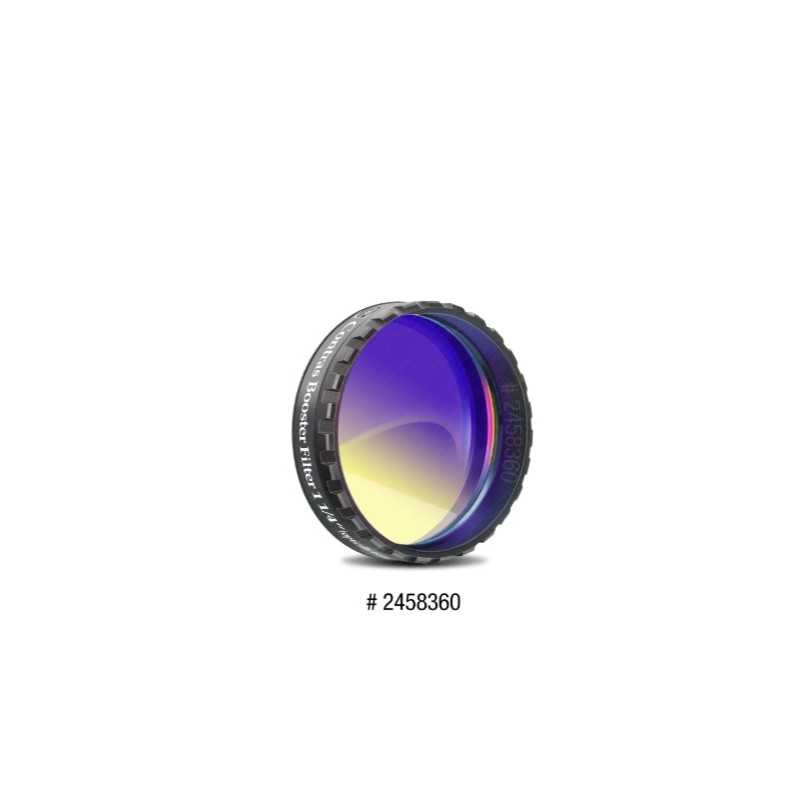







Designed to correct chromatic aberration and reveal finer detail, the Baader Contrast Booster 1.25 inch combines over 95% transmission, integrated UV IR blocking and plane-optical polishing for visual and imaging use.
Sharper detail, stronger contrast and significantly reduced false colour are the main objectives of the Baader Planetarium Contrast Booster. In its 1.25 inch format, it integrates easily into visual and imaging systems using this standard while providing a carefully engineered spectral response.
Its effect is particularly valuable with fast achromatic refractors. False-colour fringes and the bluish hue responsible for reduced contrast are strongly suppressed, allowing the actual optical quality of the objective to become much more apparent.
On the Moon, this correction produces cleaner detail and better-defined boundaries. Image brightness remains high and colour rendition stays relatively natural, with only a slight yellowish tint instead of the strong darkening associated with traditional green contrast filters.
Jupiter and Mars also benefit from the spectral selection. Surface structures become easier to distinguish while transmission exceeding 95% maintains a bright image even when higher magnifications are used.
Terrestrial observation benefits from the same reduction in bluish haze and atmospheric stray light. Distant subjects can appear more clearly defined when atmospheric scattering would otherwise reduce contrast.
A significant amount of urban light pollution and atmospheric Airglow is also suppressed. Mercury-vapour emissions around 435 nm and sodium-vapour street-light emissions between 570 and 590 nm encounter transmission levels of only approximately 0.3 to 3%.
This selective suppression helps produce a significantly darker sky background and makes the Contrast Booster particularly useful for observation and imaging from light-polluted towns, cities and metropolitan areas.
Transmission nevertheless remains high at several important astronomical wavelengths. Baader specifies approximately 98% transmission at H-alpha, 87% at H-beta and 82% at OIII, preserving a high proportion of useful light in these spectral regions.
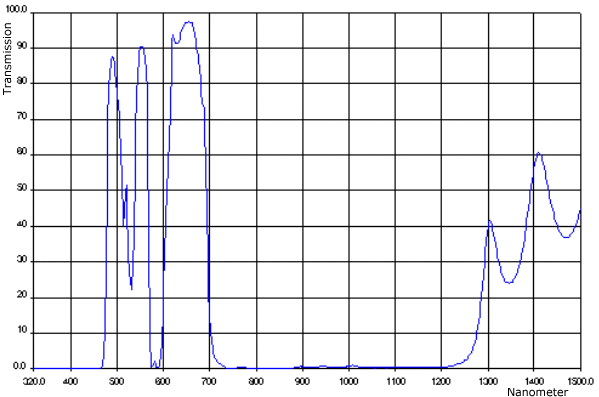
Digital imaging additionally benefits from integrated UV IR blocking. Unfocused infrared wavelengths can produce enlarged or poorly defined stars with digital and CMOS cameras that remain sensitive in the red. Suppressing this radiation helps maintain better-defined stellar images.
The optical substrate consists of neodymium-doped glass. This material contributes to colour correction and contrast enhancement, while sophisticated multilayer coatings accurately control the different spectral regions transmitted or rejected.
The glass is planeoptically polished to minimize additional errors in the optical wavefront. Baader specifies that this manufacturing quality allows the filter to be used at magnifications of 200x and above without the loss of resolution associated with simply polished filter glass.
This precision also permits the Contrast Booster to be positioned relatively far ahead of the focal plane. It is therefore suitable for use in front of a binocular viewer and for selected afocal digital imaging configurations.
The rear surface carries a 7-layer hard multicoating with a specified reflection of only 0.25%. The front surface uses a 23-layer dielectric long-pass blocker.
Coatings on both surfaces are ion-beam hardened for very high mechanical durability, while their edges are sealed to prevent deterioration over time. Baader specifies that the surfaces may be cleaned using Baader Optical Wonder Fluid.
Standard filter threads are provided on both sides of the cell. This allows direct installation on compatible accessories and enables the Contrast Booster to be stacked with another filter when required.
For solar observing, the Contrast Booster can contribute to improved contrast and sharpness, but it provides no standalone solar protection. Baader specifies that it may only be used in combination with correctly installed Baader AstroSolar Safety Film.
With its specialised spectral response and high optical quality, the Baader Planetarium Contrast Booster 1.25 inch is well suited to lunar and planetary observers, users of achromatic refractors and CMOS imagers looking for cleaner, sharper and more contrasted results.
• Manufacturer: Baader Planetarium
• Product: Contrast Booster
• Manufacturer SKU: 2458360
• EAN Code: 4047825009517
• Filter type: Bandpass
• Size: 1.25 inch
• Shape: Round
• Mounting: LPFC 6 mm cell
• Filter glass thickness without cell: 1 mm
• Net weight: 0.01 kg
• Substrate: Neodymium-doped glass
• Optical finish: Planeoptically polished
• AR coating: Phantom Coating Group
• Transmission range: Multiple bands according to spectral curve
• Maximum transmission: Over 95%
• H-alpha transmission: Approximately 98%
• H-beta transmission: Approximately 87%
• OIII transmission: Approximately 82%
• Transmission around 435 nm: Approximately 0.3 to 3% in the relevant region
• Transmission between 570 and 590 nm: Approximately 0.3 to 3% in the relevant region
• Rear surface: 7-layer hard multicoating
• Rear coating reflection: 0.25%
• Front surface: 23-layer dielectric long-pass blocker
• Coating hardening: Ion-beam hardened on both surfaces
• Coating edges: Sealed
• Integrated UV IR blocking: Yes
• Chromatic aberration correction: Yes
• Bluish hue reduction: Yes
• Atmospheric stray-light reduction: Yes
• Urban skyglow reduction: Yes
• Airglow reduction: Yes
• Lunar observation: Yes
• Planetary observation: Yes
• Terrestrial observation: Yes
• Solar observation: Only with Baader AstroSolar Safety Film
• Digital imaging: Yes
• Red-sensitive CMOS cameras: Yes
• Suitable in front of binocular viewers: Yes
• Afocal projection: Yes
• Suitable at 200x magnification and above: Yes
• Filter threads on both sides: Yes
• Stackable with other filters: Yes
• Packaging: Single filter

Specific References
Designed to correct chromatic aberration and reveal finer detail, the Baader Contrast Booster 1.25 inch combines over 95% transmission, integrated UV IR blocking and plane-optical polishing for visual and imaging use.