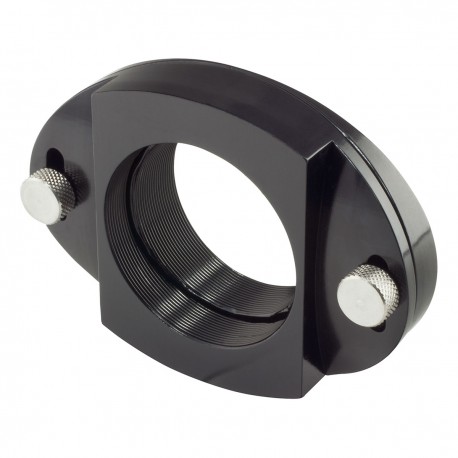







The DayStar Interference Eliminator is designed to remove interference fringes commonly seen in monochrome imaging such as Hydrogen Alpha. Positioned directly in front of the camera, it tilts the sensor without affecting framing or focus, improving image quality in solar astrophotography.
The DayStar Interference Eliminator T thread M42 is designed to solve a common issue in monochrome astrophotography, especially in Hydrogen Alpha imaging. When using electronic sensors at long focal ratios, patterns of light and dark lines can appear in images. These patterns, known as interference fringes or Newton rings, are caused by internal reflections and interference within the sensor.
The device works by slightly tilting the camera relative to the optical axis while keeping the center of the sensor fixed. This changes the angle of incidence and internal optical paths, reducing or eliminating interference without affecting framing, focus or vignetting under normal conditions.
Installation and use must be precise. The eliminator must be placed directly in front of the camera in the optical train. The distance from the male T thread flange to the sensor focal plane must be exactly 55 mm. With DSLR cameras and standard T rings, this distance is automatically achieved and no spacers are required. With CCD or webcam cameras, T thread spacers may be required to reach the 55 mm distance. Incorrect spacing will shift the optical axis and change focus when tilt is adjusted.
For use, slightly loosen the thumbscrews and gradually separate the two halves to introduce tilt. Take test images to check for interference. Increase tilt progressively if needed. Only minimal tilt should be applied, as excessive tilt can degrade focus at the top and bottom of the image, especially in fast focal ratio systems. If maximum tilt does not resolve the issue, reverse the tilt direction. In severe cases, interference may not be fully removed but can be reduced to a level correctable with flat fielding or image processing.
With large sensors such as full frame 36 x 24 mm DSLR cameras, some vignetting may occur at maximum tilt due to mechanical limitations and T thread diameter. This does not occur with smaller sensors such as APS C.
The DayStar Interference Eliminator is designed to remove interference fringes commonly seen in monochrome imaging such as Hydrogen Alpha. Positioned directly in front of the camera, it tilts the sensor without affecting framing or focus, improving image quality in solar astrophotography.